DVDs, Books, and other Materials about Child Development and Children with Disabilities |
 Home Page |
 Curriculum Vitae |
  Products by Topics |
 FAQs |
 Free Downloads |
 Resource Links |
 Order Info |
 Contact Us |
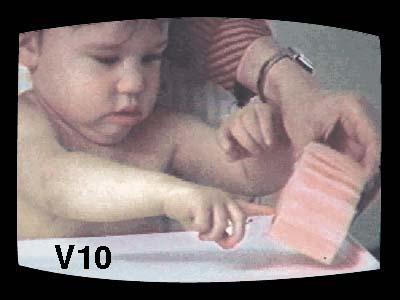
Normal Hand Development: Birth to 15 Months (1981)
35 minutes. V10P: $90
 Administration of the Erhardt Developmental Prehension Assessment: The Child with Developmental Disabilities (1983)
55 minutes. V11P: $95
This video demonstrates administrative procedures for using the EDPA to assess hand function in a school-aged child with
cerebral palsy, illustrating appropriate positioning, materials, verbal
instruction, and presentation techniques.
 Administration of the Erhardt Developmental Prehension Assessment: The Adolescent with Developmental Disabilities
(1994)
Administration of the Erhardt Developmental Prehension Assessment: The Adolescent with Developmental Disabilities
(1994)
55 minutes. V18P: $95
This video demonstrates
administrative procedures for using the EDPA to assess hand function in
the same individual as an adolescent nine years later),
illustrating appropriate positioning, materials, verbal instruction, and
presentation techniques.
 Normal Components of Hand Preference (1999)
30 minutes. V24P: $90
CLICK ON THIS
THUMBNAIL IMAGE TO VIEW A FULL SIZE VIDEO CAPTURE.
This video
presents unilateral, bilateral, and bimanual hand movements of 5 typical
elementary-age children, following the format of the Erhardt Hand
Preference Assessment (EHPA), 2006 version. It is organized into
sections of exploratory/sensory movements, gestures, and functional
tasks, which include power (resistive), precision (fine manipulation),
and power/precision (combination). Functional tasks are also grouped
according to occupational performance areas: activities of daily living,
work/productive activities, and play/leisure activities.
Normal and
Atypical Hand Function (1996)
35 minutes. V22P: $95
CLICK ON
THIS THUMBNAIL IMAGE TO VIEW FULL SIZE VIDEO CAPTURES.
1. Components of Hand Function in a
Normal Young Adult
This video presents hand movement patterns of
a normal young adult, including the approach, grasp, manipulation, and
release clusters of the EDPA-S (short screening form).
2. Atypical
Hand Function in Persons with Disabilities
This video presents
examples of 15 children and adults with various physical and multiple
disabilities, who were evaluated with the EDPA. Their atypical arm and
hand patterns are linked with their specific medical conditions,
compensations they have developed, and implications for function in
home, school, and community environments.
Normal and Atypical Hand
Preferences (1999)
35 minutes. V26P: $95
CLICK ON THIS
THUMBNAIL IMAGE TO VIEW FULL SIZE VIDEO CAPTURES.

1. Emerging and Mature Hand Preferences
and Congruencies (2000)
This video, winner of an Excellence in
Public Access Television Award, presents unilateral hand movements of a
mother and her 2-year-old child, following the format of the Erhardt
Hand Preference Assessment short screening form (EHPA-S).
2.
Factors Influencing Hand Preference in Persons with
Disabilities
This video presents examples of 7 children and
adults with various physical and multiple disabilities, who were
evaluated with the Erhardt Hand Preference Assessment (EHPA). Their
choices of hand preference are linked with their specific medical
conditions and functional compensations for missing components of
unilateral, bilateral, and bimanual hand development.